


Why Wristband Personalisation Matters for Events and Operations
The instinct to personalise wristbands is sometimes dismissed as a purely cosmetic concern. In practice, the opposite is true. A well-personalised wristband is an operational tool that reduces errors, speeds entry, deters fraud, and strengthens brand recall long after the event has ended.
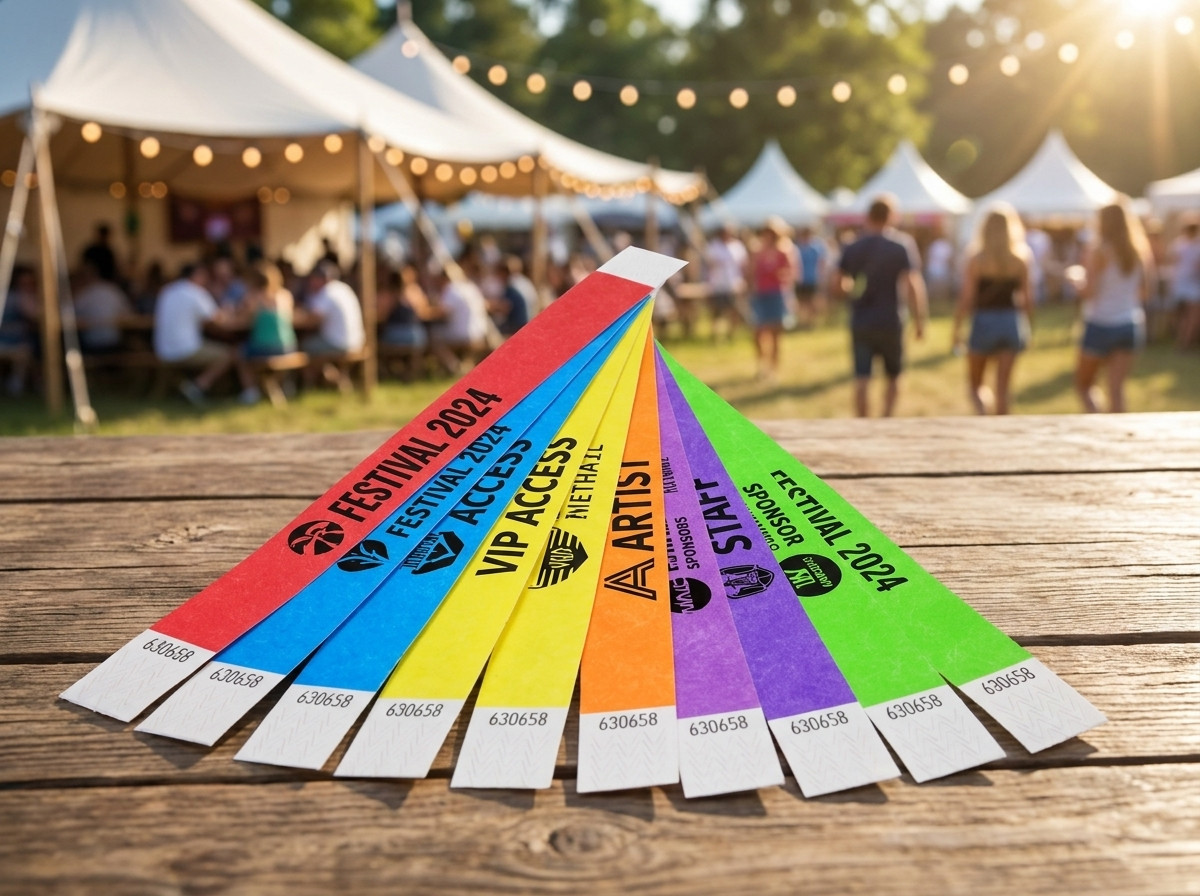
Consider a multi-zone festival. Without colour differentiation, staff at every internal gate must individually check a list or ask for a separate ticket. With colour coding — a different background hue for VIP, general admission, crew, and press — the check is instantaneous and visual. Security staff do not need to read; they need only to see. That single personalisation decision can cut queue times by a meaningful margin at busy transition points.
For hotels running all-inclusive programmes or day-pass schemes, a wristband printed with the property name, the access date, and a bold colour assigned to that day prevents guests from the previous night retaining access on a new day. The personalisation is doing compliance work that would otherwise require staff time.
At medical or charity events where participant welfare is a priority, a wristband printed with a unique sequential number, an emergency contact line, or a QR code linking to a participant profile becomes a genuine safety asset. The wristband is personalised not for aesthetics but for duty of care.
None of this requires a large print run or a specialist design team. Working with a manufacturer that provides free graphic design support means that even a small community event organiser can produce a professionally printed, fully personalised wristband without needing in-house creative skills.
Colour: The First and Most Powerful Personalisation Tool
Colour is the fastest channel of communication a wristband has. The human eye processes colour before it reads text, which makes background colour the single most important personalisation choice for any multi-tier or multi-day event.
Background Colour
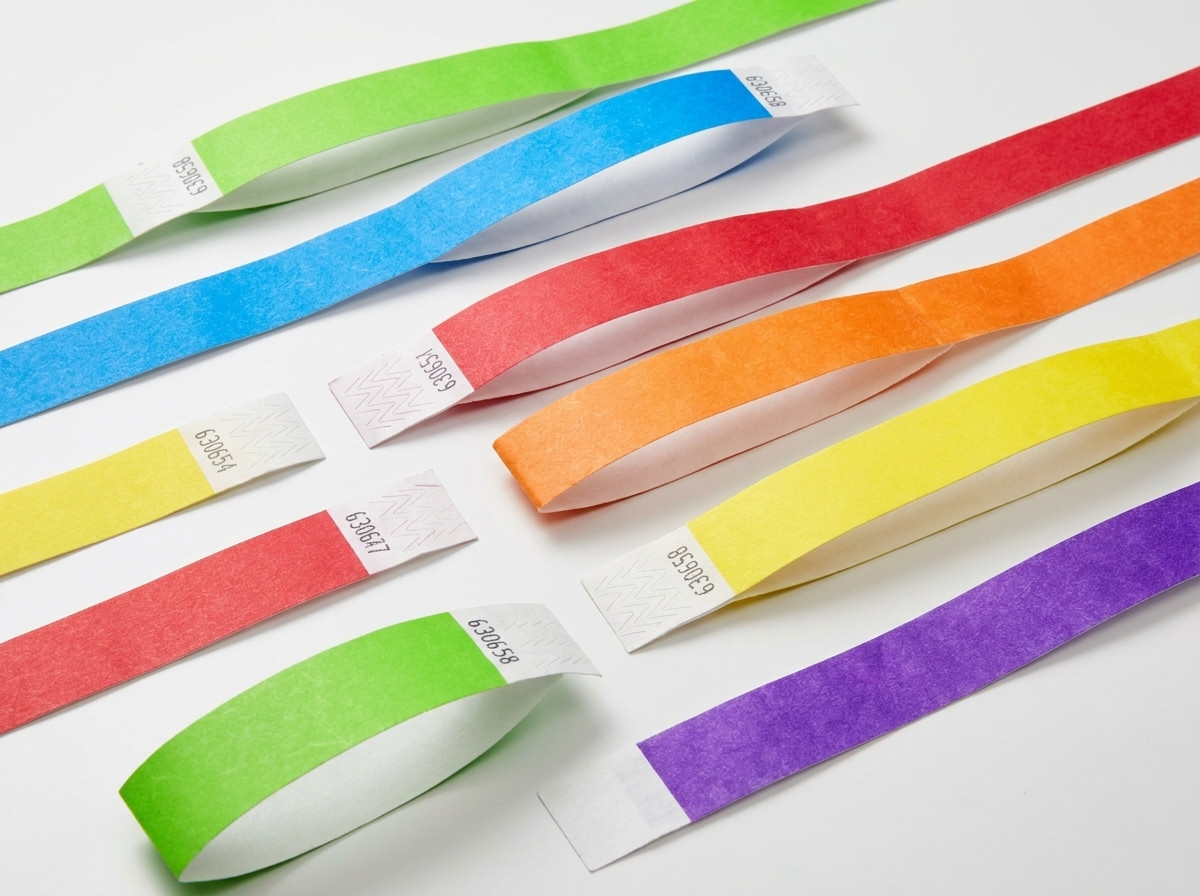
Tyvek wristbands are available in a wide spectrum of base colours, and vinyl (PVC) wristbands can be manufactured in an equally broad range. When selecting background colours for an event, the guiding principle should be instant distinction at a distance. A steward standing three metres from a guest should be able to confirm the correct colour band without the guest needing to raise their arm.
Practical considerations for colour selection include:
- High contrast pairs: Avoid colours that look similar under artificial light — navy and black, or dark green and dark grey, can be indistinguishable at dusk. Opt for clearly distinct hues: yellow, red, blue, green, orange, white.
- Day coding: For multi-day events, assign a distinct colour to each day so expired bands are immediately visible.
- Zone coding: Use one colour system for access tiers (e.g. general, VIP, backstage) and keep it consistent across all printed materials so staff learn the code before doors open.
- Brand alignment: Where operational clarity allows, select a background that complements your brand palette. A sponsor activation band in brand colours doubles as a marketing asset.
Ink and Print Colour
Beyond the background, the colour of the printed artwork matters. High-definition printing on Tyvek and vinyl supports full-colour artwork, meaning your logo's gradient, your sponsor's pantone, and your event photography can all reproduce accurately. For simple single-colour prints — a black logo on a white Tyvek band, for instance — the contrast is crisp and legible even at small sizes. For richer designs, full-colour HD printing unlocks photographic quality on the band surface.
When designing for legibility, ensure there is sufficient contrast between the printed text/logo and the background. Light print on a light background and dark print on a dark background both fail readability tests under the variable lighting conditions of real events.
Artwork and Logo Printing: Getting Your Brand on the Band
Printed artwork is where personalisation shifts from functional to branded. A wristband bearing your event or venue logo creates a tangible souvenir moment — many festival-goers keep their wristbands for years. It also anchors the wristband unmistakably to your specific event, making duplication by bad actors significantly harder.
What Can Be Printed
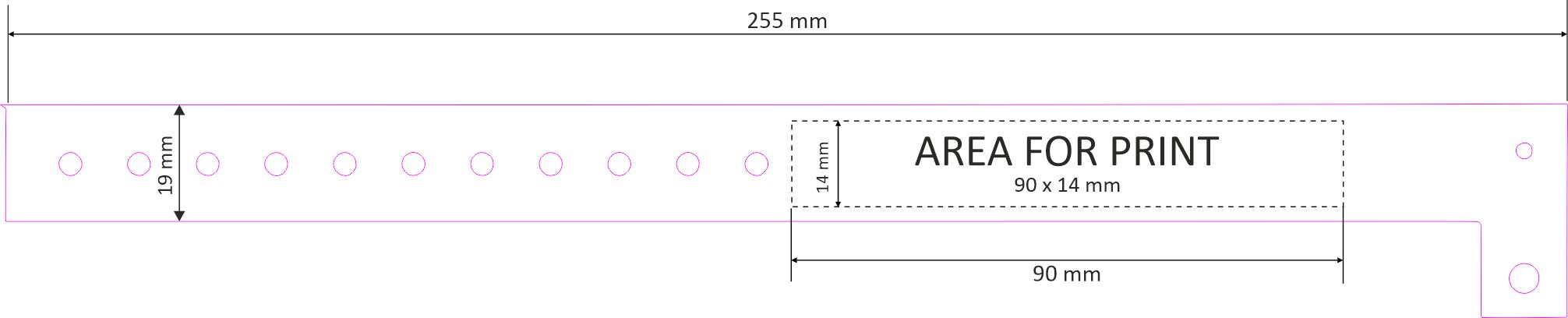
On both Tyvek and vinyl wristbands, the printable area runs along the face of the band. Typical printed elements include:
- Event or festival name in bold typography
- Organiser or venue logo
- Sponsor logos (one or multiple, depending on band width)
- Event date or date range
- Access tier label (e.g. «VIP», «General Admission», «Crew»)
- Website URL or social media handle
- Custom tagline or promotional message
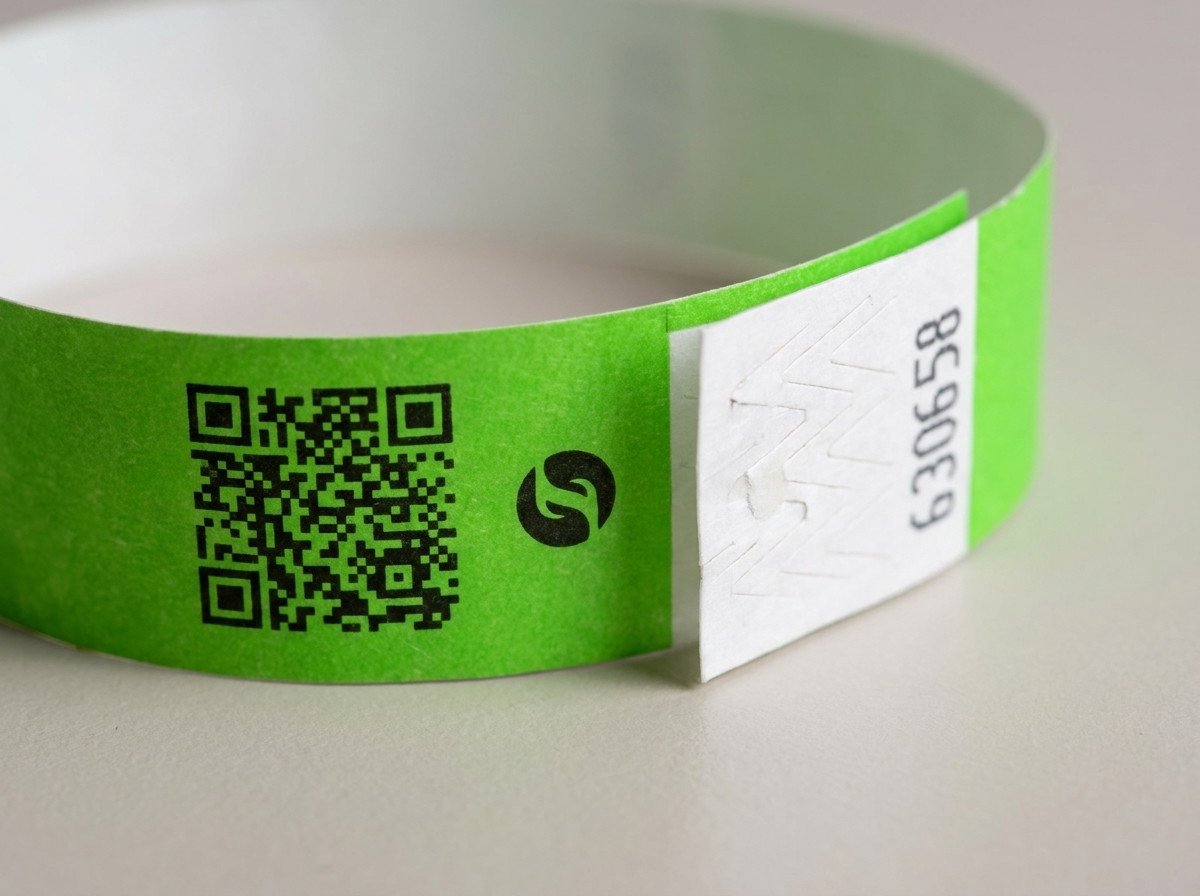
- Barcode or QR code (see the Identification Codes section below)
- Sequential unique numbering
Print Quality Across Materials
Tyvek wristbands, made from a high-density polyethylene fibre, accept HD printing extremely well. The surface is smooth, the ink adheres sharply, and fine details — including small-point text and intricate logo linework — reproduce clearly. Because Tyvek is a paper-like material, it can be fed through specialist wristband printers at speed, which is why same-day production is achievable when an order is placed early in the working day.
Vinyl (PVC) wristbands offer a slightly different canvas. The material is heavier, more rigid, and has a glossy quality that makes full-colour photographic prints particularly vivid. For events where the wristband will be worn for several days — a camping festival, a holiday resort — vinyl is the preferred substrate because it resists moisture and wear. The print remains sharp even after days of immersion in sweat, rain, or pool water.
Free Design Support
One persistent barrier to personalisation for smaller events is the perceived complexity of producing print-ready artwork. Vector logos, bleed areas, colour profiles, and resolution requirements are all legitimate technical considerations — but they should not be the organiser's problem. The right manufacturing partner absorbs that complexity entirely, with a design team that takes a brief (logo files, colour preferences, text content) and returns a complete, professional, print-ready layout at no additional cost. This means a school fair committee and a major festival production company can access the same quality of printed wristband without needing the same in-house resources.
Identification Codes: Barcodes, QR Codes, and Sequential Numbering
Printed codes transform a wristband from a passive visual identifier into an active data interface. They are the bridge between the physical band on a guest's wrist and the digital systems managing your event — ticketing platforms, access control software, cashless payment systems, or attendance tracking tools.
Barcodes
The linear barcode (in formats such as Code 128 or EAN-13) is the most widely supported format across entry scanning hardware. Barcode scanners used at event gates are typically fast, inexpensive, and robust. A barcode printed on a Tyvek or vinyl wristband can be scanned thousands of times without degradation, provided the print contrast is sufficient — dark ink on a light background is the reliable standard.
For large-volume events where scan speed is critical, the linear barcode remains the preferred choice. A practised scanner operator can process a queue faster with a barcode than with any other code format because the scanner simply needs to see the bars in a straight pass, with no alignment requirement.
QR Codes
The QR code encodes significantly more data than a linear barcode and can be read by any smartphone camera as well as dedicated scanners. For events using smartphone-based ticketing verification, or for activations where guests are invited to scan their own wristband to access digital content, a QR code is the natural choice.
QR codes also have a built-in error correction capability, meaning they remain scannable even if the surface is lightly scratched or partially obscured — an important practical advantage on a wristband worn for multiple days. The minimum printable size should be respected (typically no smaller than 2 cm × 2 cm for reliable scanning), and adequate quiet zone (white space) around the code must be maintained in the design layout.
Sequential Numbering
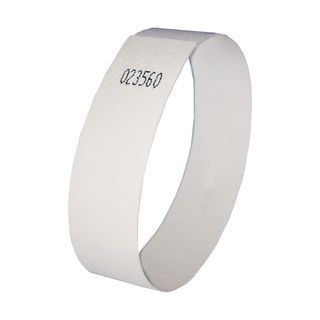
Sequential unique numbering — where each wristband in a print run carries a distinct incremental number — serves both security and operational functions. Operationally, numbered wristbands allow organisers to account for every unit: how many were issued, which number range was given to which zone, and whether any bands were returned or unused. This is particularly valuable for ticketed events reconciling attendance against sales.
From a security perspective, sequential numbering makes duplication detectable. If two individuals present with the same number, the system flags a problem instantly. Combined with a barcode or QR code that encodes the same number digitally, the wristband becomes a robust anti-fraud instrument without requiring expensive materials.
Sequential numbers can be printed in human-readable format, encoded into a barcode or QR code, or both simultaneously — the choice depends on whether you need staff to read the number directly or whether scanning is the primary workflow.
Choosing the Right Material for Your Personalisation Goals
Personalisation options are broadly consistent across Tyvek and vinyl, but the material choice shapes the experience of wearing and using the wristband. Understanding the trade-offs helps you match the specification to your event type.
Tyvek Wristbands
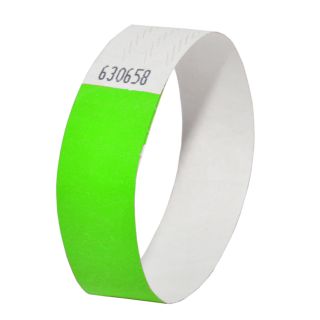
Tyvek is the industry standard for single-day or short-duration events. It is lightweight, comfortable against the skin, and tear-resistant enough that it cannot be removed and re-applied — once on, the closure is permanent, which is the core security function of a disposable wristband. The material takes HD printing exceptionally well, and because it is produced in sheets that run through printing presses at speed, it is the format that supports same-day production when lead time is critical.
For event organisers who have had a supplier fail to deliver, or who simply left the wristband order until the last moment, Tyvek printed and dispatched on the same day via express courier services is frequently the difference between a professionally run event and a logistical embarrassment. The speed of production is a genuine material property, not just a service promise.
Tyvek wristbands are not appropriate for multi-day wear in wet conditions. The material, while moisture-resistant, will eventually soften and lose integrity if submerged repeatedly. For festivals where guests sleep on site and shower daily while wearing the band, vinyl is the better choice.
Vinyl (PVC) Wristbands
Vinyl wristbands are manufactured from flexible PVC, closed with either a snap-lock or a metal crimp. They are substantially more durable than Tyvek, waterproof by nature, and designed for multi-day wear. The security closure means the band cannot be removed and transferred to another person without visible damage — important for resort access control where a band may grant multiple days of facility use.
The print surface on vinyl supports vivid full-colour artwork, and the slightly glossy finish gives the finished band a premium aesthetic that many event organisers prefer for VIP programmes, charity fundraisers, or branded hospitality environments. Vinyl wristbands are often kept as keepsakes, extending the brand exposure beyond the event itself.
The trade-off is that vinyl production is less instantaneous than Tyvek — there is a manufacturing step involving the closure mechanism that adds to the production timeline. However, with express production workflows and fast courier dispatch via DHL Express or FedEx Express, multi-day vinyl wristbands can still reach organisers with very short lead times.
Anti-Transfer Security Closures
Both Tyvek and vinyl wristbands can be specified with anti-transfer closures — adhesive or mechanical mechanisms designed so that any attempt to remove and reapply the band leaves visible evidence of tampering. This is the physical security complement to all the printed personalisation described above: even if someone replicates the print perfectly, they cannot transfer a genuine closure from one wristband to another without destroying it.
When combining printed identification codes with anti-transfer closures, the wristband becomes resistant to the two most common fraud vectors: visual forgery and physical transfer. For paid access events, this combination represents the most cost-effective security solution available at the disposable wristband tier.
Practical Personalisation Checklist Before You Order
Before placing a personalisation order, it helps to confirm every variable so that production can begin immediately without clarification delays — particularly important when lead time is short.
- Background colour(s): How many zones or days? One colour per category.
- Artwork files: Logo in vector format if available; if not, the design team can work from high-resolution raster files or a verbal brief.
- Text content: Event name, date, access tier labels, URL, any sponsor names. Final, proofread copy only.
- Code type: Barcode, QR code, sequential numbering, or a combination? Confirm the encoding format if connecting to an existing scanning system.
- Quantity per colour: Exact quantities allow accurate production and avoid unnecessary waste.
- Material: Tyvek for single-day or short events; vinyl for multi-day or waterproof requirements.
- Closure type: Standard adhesive or anti-transfer security closure?
- Delivery address and required date: Express production and dispatch via DHL Express or FedEx Express can meet very tight deadlines — but confirming the delivery requirement up front ensures the right service level is selected.
With these details confirmed at order placement, a professional design proof can be turned around rapidly, approved, and sent to production without back-and-forth delays. For truly urgent orders — a same-day Tyvek production scenario — having all content ready at the moment of ordering is the single most important thing an organiser can do to ensure on-time delivery.