


Understanding Your Event Before You Choose a Wristband
The single most important step in selecting a festival wristband is resisting the urge to jump straight to product specifications. Start with your event profile instead. Ask yourself four questions:
- Duration: Is this a single-admission afternoon event, a full-day festival, or a multi-day camping experience?
- Audience size: Are you managing 200 guests or 20,000?
- Security requirement: Do you need to distinguish between ticket tiers, re-entry rights, age groups, or staff?
- Environment: Will attendees be in water (rain, pools, water features)? Will they sleep in the wristband?
Your answers map almost directly to a wristband material. A one-day indoor conference needs a cost-effective, high-visibility band that tears if tampered with. A weekend outdoor festival needs something that survives rain, sweat, and sleep without fading, peeling, or being transferred between wrists. Once you know your event profile, every subsequent decision becomes cleaner.
It is also worth thinking about volume tiers. Larger orders reduce per-unit cost significantly, but more importantly, they allow you to use colour coding across multiple zones or access levels without a big budget premium. Plan your tiers — General Admission, VIP, Crew, Under-18 — before you reach out to your supplier, so artwork and quantities can be confirmed in a single production run.
Tyvek Wristbands: The Go-To Choice for One-Day Events
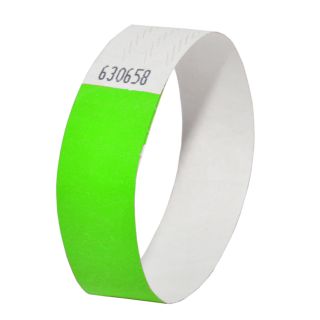
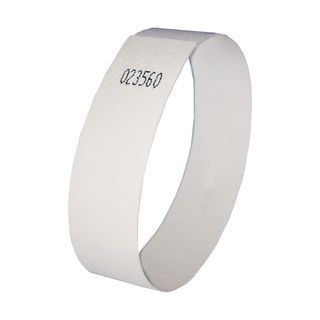
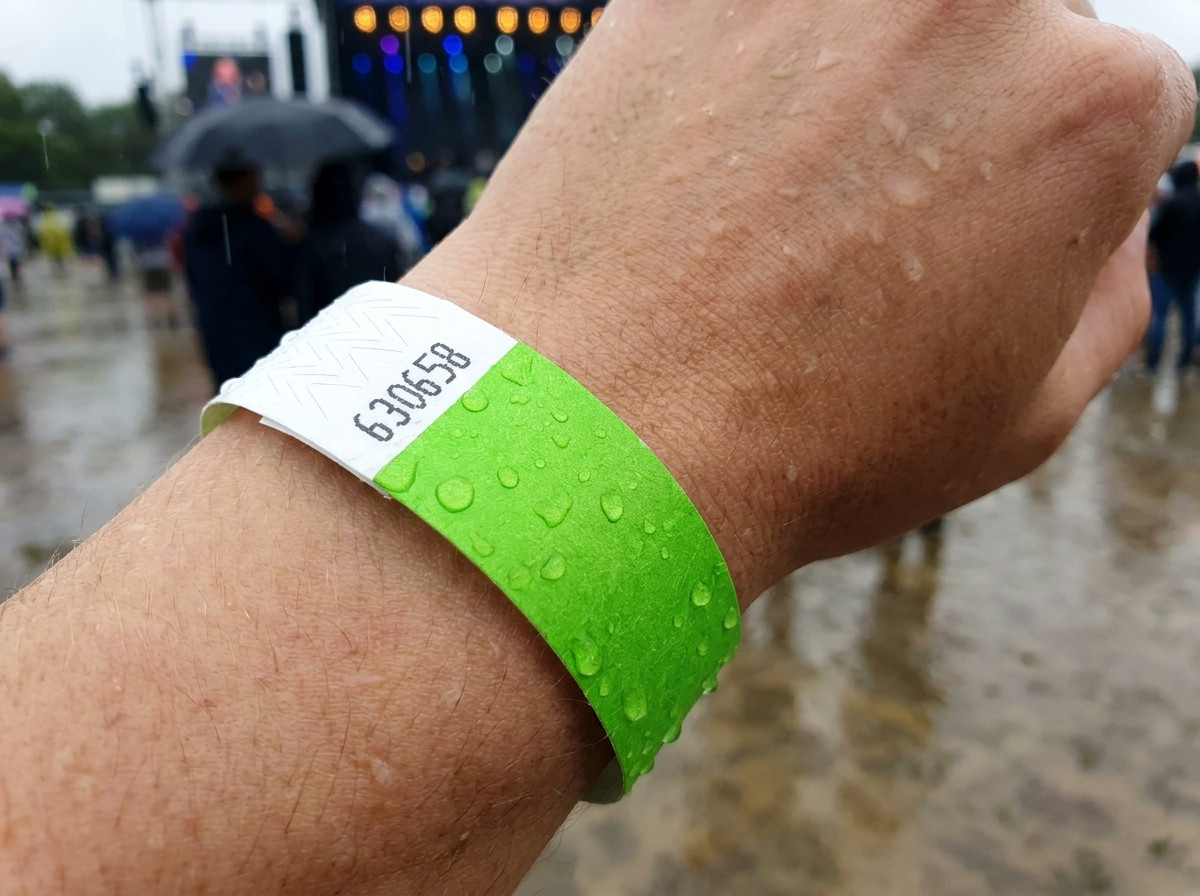
Tyvek is a spunbonded polyolefin material made by DuPont — it looks and feels like paper but is actually a non-woven synthetic fibre. That distinction matters enormously in a festival context. Tyvek is tear-resistant in the sense that it will not accidentally rip or shred during normal wear, yet it cannot be removed intact and transferred to a second wrist. Once the self-locking adhesive tab is closed, any attempt to slide the band off or force the closure open leaves visible evidence of tampering. That is the fundamental security proposition of Tyvek.
From a practical standpoint, Tyvek wristbands are lightweight and breathable, making them genuinely comfortable for a full festival day. They accept high-definition printing across the full band width, so your logo, event name, and access-tier colours come through clearly. Sequential numbering and barcodes can be printed during the same production run, enabling fast electronic scanning at the gates without adding complexity or cost.
Ideal use cases for Tyvek:
- Single-day festivals and concerts
- Day events at theme parks, fairs, and markets
- Short conferences and trade shows
- Events where budget is a priority and duration is under 24 hours
- Large-volume orders where per-unit cost matters
Limitations to be aware of: Tyvek is not designed for multi-day wear in wet or heavily physical conditions. Prolonged immersion — think water parks or camping in heavy rain — can soften the adhesive and cause premature failure. If your event runs across two or more days, or involves significant water exposure, vinyl/PVC is the stronger choice.
One practical advantage that is easy to overlook: Tyvek wristbands can be printed the same day they are ordered. When an event organiser realises on a Monday morning that their Friday festival has no wristbands, same-day production combined with express courier delivery via DHL Express or FedEx Express can still get the bands on site in time. That rescue scenario is more common than most people admit, and Tyvek makes it possible.
Vinyl (PVC) Wristbands: Built for Multi-Day Festivals
Vinyl wristbands — also called PVC wristbands — are a completely different category of product. They are manufactured from a soft, flexible plastic that is waterproof, highly durable, and resistant to the kind of continuous wear that a three-day camping festival demands. A well-made vinyl wristband worn from Friday afternoon to Sunday night should still look presentable when the wearer finally cuts it off.
The closure mechanism on a vinyl wristband is typically an anti-transfer snap or a sliding plastic lock. Anti-transfer closures are specifically engineered so the band cannot be removed and re-applied — the locking tab deforms or breaks when forced, making any attempt to share a wristband immediately visible to security staff. This level of tamper-evidence is essential when a single wristband is worth three days of festival access.
Print quality on vinyl is excellent. Because the material is smooth and non-porous, colours are vibrant and images sharp. Full-colour artwork, sponsor logos, event branding, and QR codes all reproduce faithfully. Sequential numbering is equally straightforward, giving each wristband a unique identifier that can be cross-referenced against a ticketing database for cashless payments or controlled re-entry.
Ideal use cases for vinyl/PVC:
- Multi-day music festivals and camping events
- Water parks, beach clubs, and pool events
- VIP and premium-tier identification where presentation matters
- Events with complex re-entry or zone management requirements
- Hotel resort wristbands for all-inclusive stays
Limitations to consider: Vinyl wristbands cost more per unit than Tyvek, which is a relevant factor when ordering tens of thousands of bands for a large general admission crowd. They are also slightly less breathable than Tyvek in hot weather, though modern soft-PVC formulations have reduced this issue considerably. For single-day events where budget is tight, the durability premium of vinyl is rarely justified.
Security Features: What Actually Prevents Fraud
Wristband security is a topic that event organisers sometimes approach with either too much or too little rigour. The goal is not to make wristbands impossible to defeat — determined fraudsters will always exist — but to make fraud difficult, slow, and visible enough that it is caught at the gate. Understanding the specific security tools available helps you build a proportionate defence.
Anti-Transfer Closures
This is the most fundamental security feature on any festival wristband. An anti-transfer closure is designed so that once the band is fastened to a wrist, it cannot be removed intact. On Tyvek wristbands, this is achieved through a self-adhesive tab that bonds firmly and tears on removal. On vinyl wristbands, a hard plastic lock deforms or snaps when the band is forced off. Both mechanisms ensure that a security team member can quickly confirm wristband integrity with a glance — no need for sophisticated equipment at the gate.
Sequential Numbering
Every wristband in an order can be assigned a unique sequential number, printed clearly on the band. This serves two purposes: it allows your team to cross-reference against a ticket manifest (ensuring the number on the wrist matches a legitimate purchase), and it enables post-event analysis of which numbers were actually used versus which were never distributed. Sequential numbering is included in the standard production process and adds no meaningful complexity to the order.
Barcodes and QR Codes
For events using electronic ticket scanning, barcodes and QR codes can be printed directly on the wristband. The scanner at your entrance gate reads the code and confirms validity against your ticketing database in real time. This is significantly faster than visual checks and far more reliable for high-throughput entrances. It also enables zone-based access control — a QR code that is valid for General Admission but not backstage, for example, can be configured in your scanning software without requiring a different physical wristband design.
Colour and Design as a Security Layer
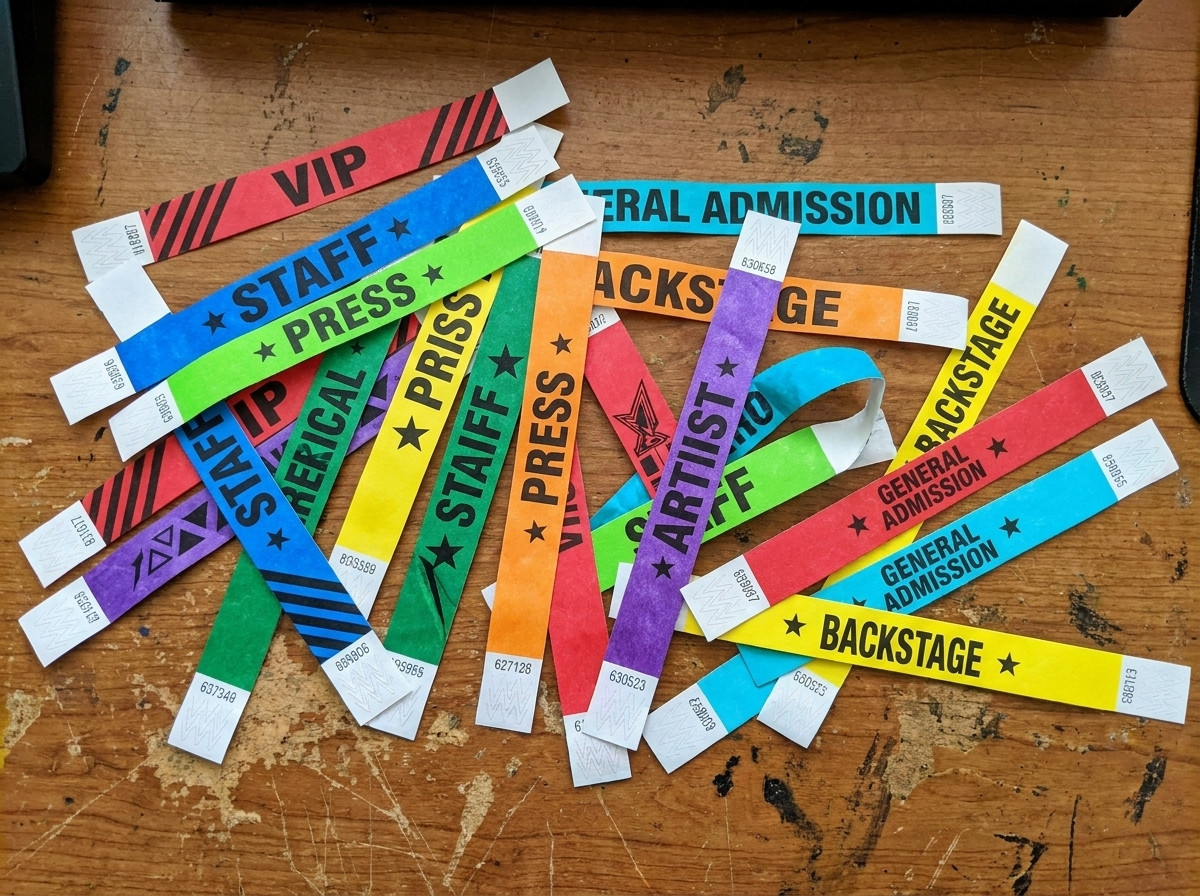
Beyond mechanical and printed security features, colour coding is one of the most practical tools available to a festival security team. Assigning a distinct colour to each day, access tier, or age group means staff can identify valid wristbands at a glance without stopping every person individually. Combined with numbered or coded wristbands, colour coding creates a layered system that is both robust and fast. When ordering, plan your colour map before briefing your supplier — this costs nothing extra and saves significant headaches at the gate.
Customisation, Artwork, and Brand Visibility
A festival wristband is not just a security tool — it is a branded touchpoint worn close to the skin for hours or days. Done well, it reinforces your festival's identity, provides a tangible souvenir that extends your brand's reach beyond the site, and adds to the overall premium feel of the event experience. Done poorly, a blurry logo on a generic band is a missed opportunity.
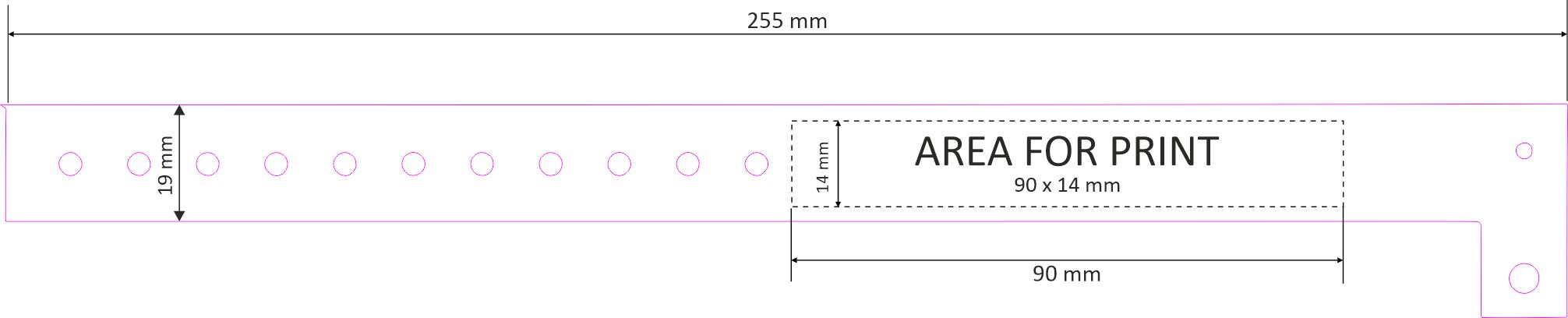
Modern HD printing on both Tyvek and vinyl supports full-colour, photographic-quality artwork across the entire wristband surface. That means you can run a gradient background, place a sponsor logo with fine detail, or reproduce an illustration from your event poster without worrying about colour accuracy or resolution loss.
Many event organisers are not graphic designers, and there is no reason they should be. A professional supplier should handle the artwork creation entirely — the organiser describes what they want (logo, event name, date, colour palette, access tier label) and receives a print-ready proof for approval before production begins. Getting professional artwork at no extra charge removes a common bottleneck, especially for smaller events that do not have an in-house design team.
Key decisions to make during the customisation process:
- Colours: Choose background and text colours that create strong contrast for both visual readability and scanning accuracy if you are using barcodes or QR codes.
- Typography: Event name and key information should be legible even when the band is worn and slightly creased.
- Logo placement: Position the main logo and any sponsor logos so they are visible when the band is worn naturally on the wrist.
- Variable data: Confirm whether you need sequential numbers, QR codes, or barcodes, and whether these need to match data in an external system.
Once the artwork proof is approved, production can begin immediately. For Tyvek wristbands, same-day production is entirely standard — the band goes from artwork approval to finished product on the same working day, ready for dispatch.
Lead Times, Last-Minute Orders, and Express Delivery
Few things cause more anxiety for an event organiser than a wristband delivery that is running late. The problem is more common than the industry likes to admit: a supplier misses a production slot, a shipment gets delayed, or — perhaps most commonly — the organiser simply forgot to place the order until the event was days away. In all of these scenarios, the question is not just whether production can be accelerated, but whether the entire supply chain can be compressed without compromising quality.
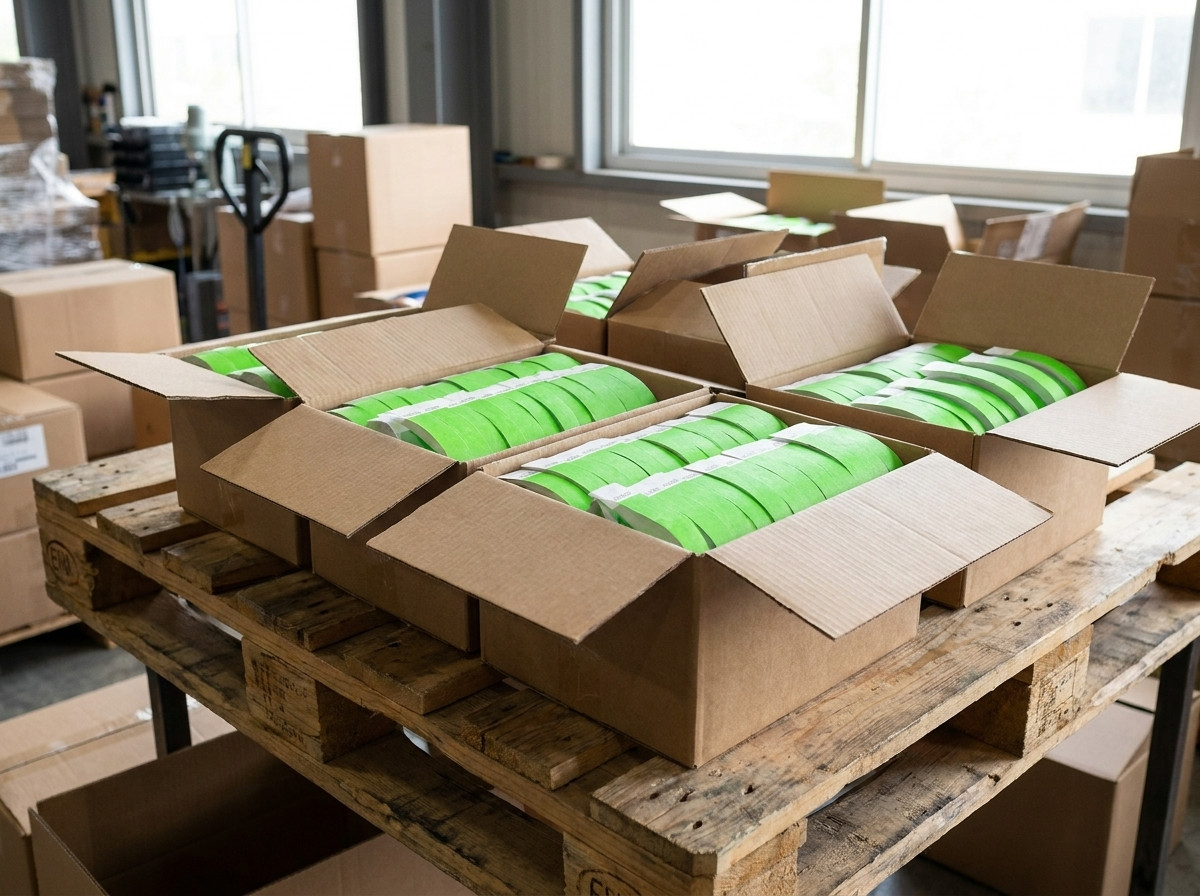
The answer depends heavily on your supplier's manufacturing setup. A business that manufactures wristbands in-house rather than relying on a third-party factory has direct control over the print queue, production scheduling, and quality checks. That control is what makes genuine same-day production possible — Tyvek wristbands ordered in the morning can be printed, finished, and handed to a courier the same afternoon, with no rush surcharge applied.
Once the package leaves production, express delivery via DHL Express or FedEx Express covers most European and international destinations within 24 to 48 hours, depending on the destination. That means an organiser in Paris who orders on a Wednesday morning can realistically have wristbands in hand by Thursday afternoon — for an event that starts on Friday. This is not a special service or an exception; it is the standard process.
For organisers who have been let down by another supplier — a factory delay, a lost shipment, a misprint that arrived too late to fix — the same same-day production and express delivery pipeline acts as a rescue mechanism. Providing the order details and artwork promptly is the only variable the organiser controls; production and logistics can be made to work even when the timeline looks impossible.
Planning tips to avoid last-minute pressure:
- Order at least two weeks before the event if possible — this gives time for an artwork proof review, production, shipping, and a buffer if anything needs to be adjusted.
- Confirm your quantity breakdown (per tier, per colour) before placing the order so production is not delayed by late changes.
- If you are integrating QR codes or barcodes with a ticketing system, test the scan workflow before the event rather than on the day.
- Order a small quantity of spare bands — 5 to 10% above your expected attendance — to cover wristbands that are damaged, lost, or needed for late additions to the crew or VIP list.
Even with careful planning, events are unpredictable. Knowing that a reliable, last-minute production option exists takes significant pressure off the planning process — and means that a late change in guest numbers or an access tier restructure does not have to become a crisis.