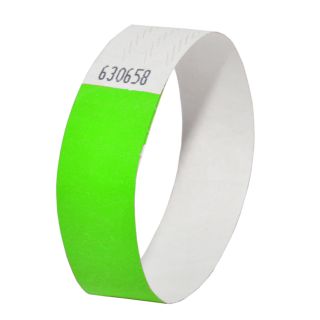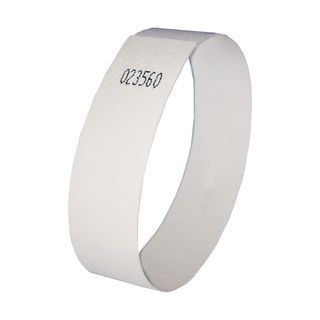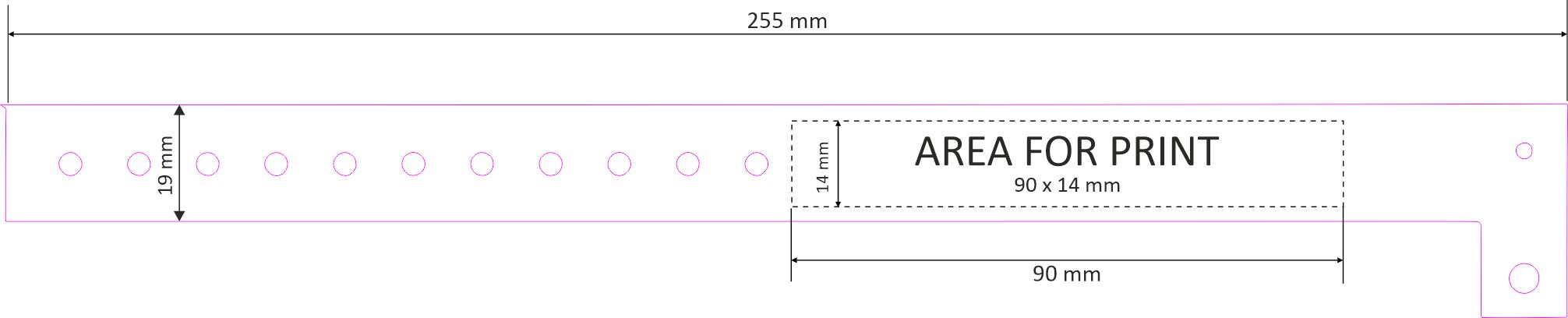



Why Wristbands Are the Gold Standard for Event Access Control
Event access management has evolved far beyond a doorman checking a paper list. Modern events — even mid-sized ones with a few hundred guests — demand a system that is simultaneously fast, tamper-proof, and visually unambiguous. Wristbands fulfil all three criteria better than lanyards, stamps, or paper tickets.
The key advantage is persistence. A wristband stays on the body throughout the event. A guest cannot hand a ticket to a friend who has already entered, cannot claim they lost their stamp in the rain, and cannot easily replicate the credential at home. Anti-transfer closures — the one-way locking mechanism used on quality Tyvek and vinyl wristbands — mean the band cannot be removed and passed on without visible destruction of the closure. Stewards see a broken or missing band immediately.
Speed is equally important. At a busy festival gate, a steward glancing at a wrist takes roughly one second per person. Cross-referencing a name list can take ten to thirty seconds. At 500 guests arriving in the same half-hour window, that difference between one second and fifteen seconds is the difference between a smooth entry flow and a traffic jam that sours the event experience before it has even started.
Finally, wristbands scale. Need to add a VIP upgrade tier on the day? Print a second colour of Tyvek that morning — the same-day production capability means organisers are not locked into decisions made weeks before the event. Need to distinguish day-one guests from day-two arrivals at a multi-day conference? Each day gets its own colour or design, and the logic is instantly legible to every member of staff without any briefing beyond a laminated colour chart at the entrance.
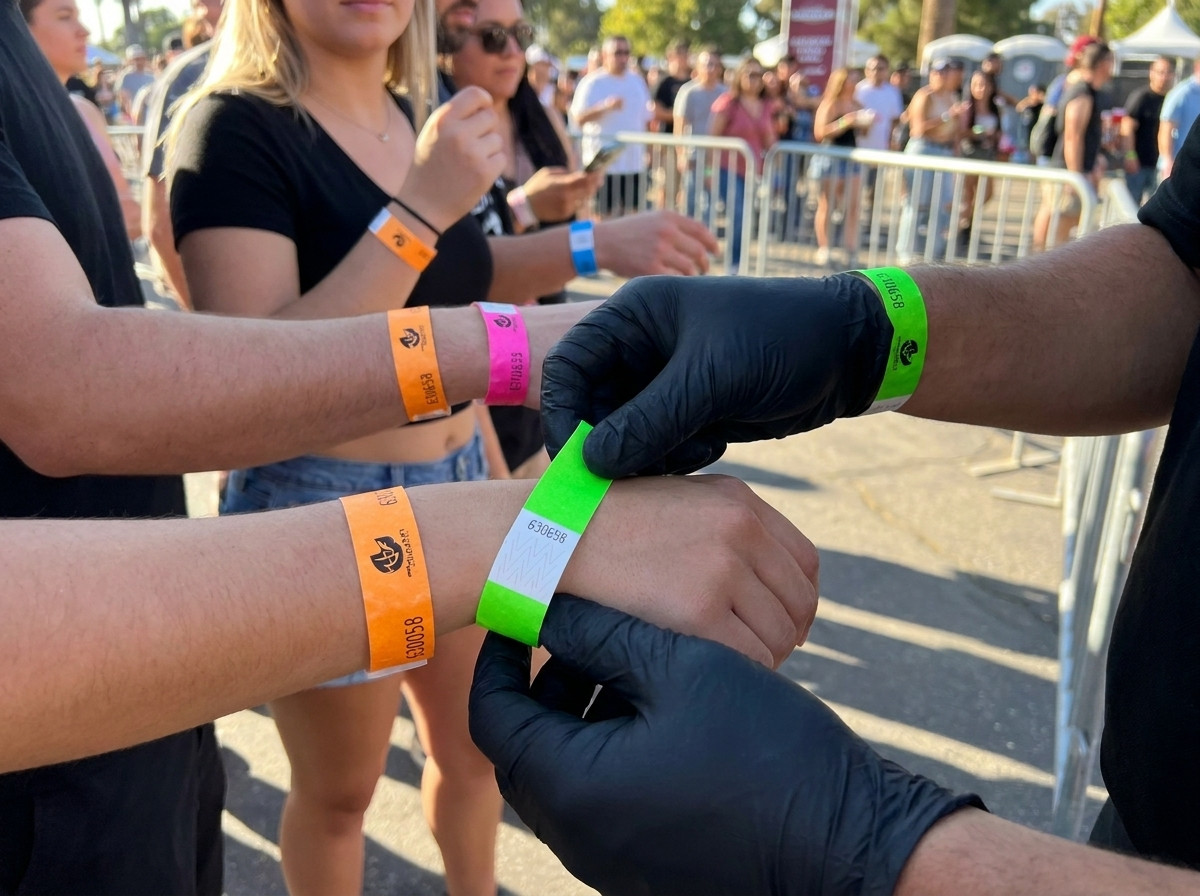
Building a Zone-Control Colour System
Zone control is the practice of restricting different areas of an event to different guest categories. Backstage, VIP lounges, press areas, staff corridors, children's zones, swimming pool decks at a hotel — all of these benefit from a tiered access architecture. Wristbands make that architecture visible and enforceable.
The most practical approach is a colour-per-zone-tier system. Assign one wristband colour to each access level, brief your team on the scheme, and post a laminated reference card at every control point. Here is a typical festival structure as an illustration:
- General admission — standard Tyvek in a base colour (e.g. blue): access to main stage and common areas.
- VIP — contrasting Tyvek or vinyl (e.g. gold or black): access to general areas plus the VIP lounge and bar.
- Backstage / artist — high-visibility vinyl (e.g. fluorescent green): access to all areas including production corridors.
- Staff / crew — distinct colour vinyl (e.g. red): all-access but visually differentiated from artists so security can identify hired contractors instantly.
- Press — secondary Tyvek colour (e.g. yellow): access to media pit, press room, and general areas but not backstage.
The number of tiers is up to you, but experienced event managers recommend keeping the palette to five or fewer distinct colours. Beyond that, stewards begin confusing shades under dim lighting or late in a long shift, which defeats the purpose.
For events spread across multiple days or time slots — multi-day conferences, hotel spa access, campsite admission — add a date or session indicator printed directly onto the band. This can be as simple as «Day 1» in large type, or a coloured stripe across a neutral background. Because the artwork is created at no extra cost as part of the free graphic design service, adding these details does not increase per-unit price or lead time.
Choosing the Right Wristband Material for Each Access Role
Not all wristbands are equal, and selecting the correct material for each zone tier is one of the most consequential decisions in your access-management plan. The two materials most relevant to controlled events are Tyvek and vinyl (PVC).
Tyvek Wristbands
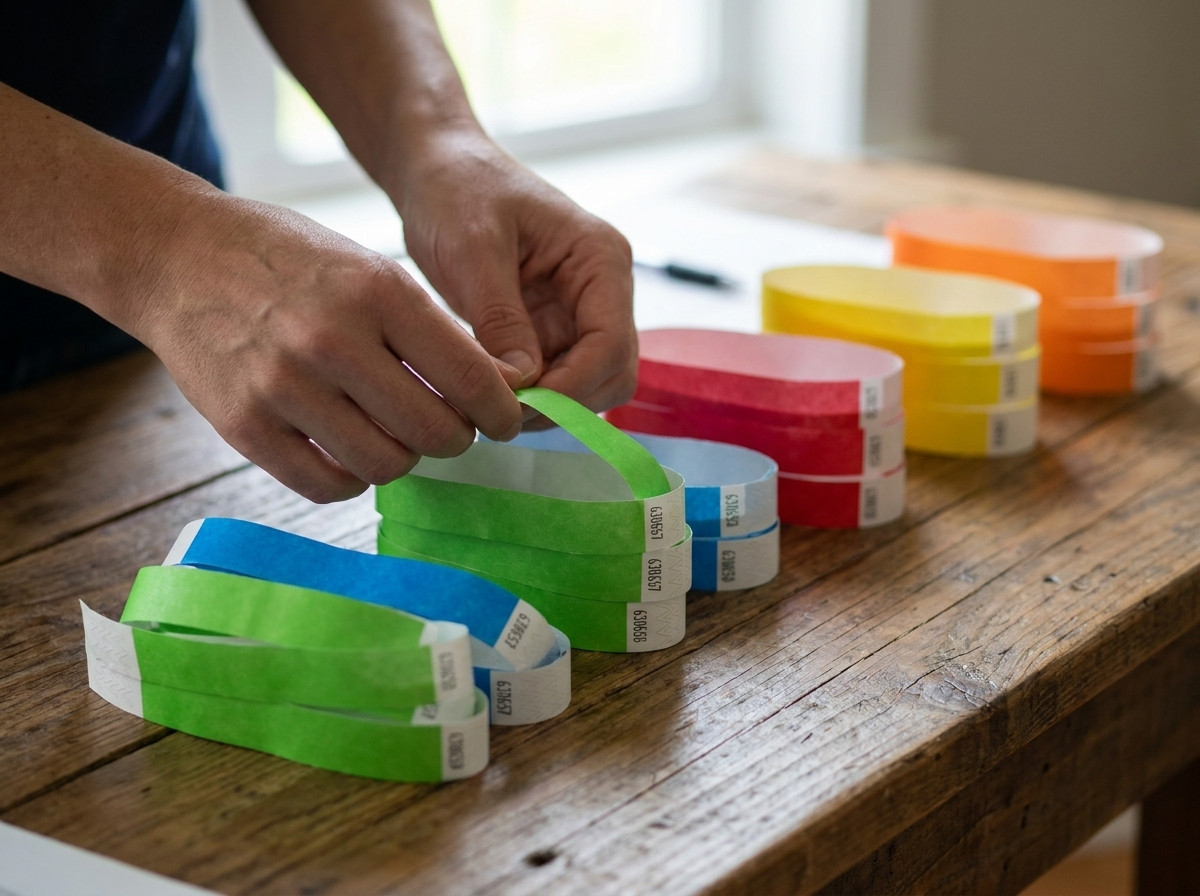
Tyvek is a high-density polyethylene fibre material that looks and feels like paper but is tear-resistant, water-resistant, and extremely lightweight. It is the dominant choice for general admission and single-day events for several practical reasons:
- Cost-effectiveness at scale: Tyvek bands are economical when ordering large quantities, which suits general-admission tiers where headcount is highest.
- Same-day production: Tyvek wristbands can be printed and dispatched the same day an order is placed — a critical advantage when event timelines compress or a supplier fails to deliver.
- High-definition print quality: Custom text, logos, event names, barcodes, and QR codes reproduce sharply on Tyvek, maintaining scannability throughout the event.
- Anti-transfer closure: The adhesive snap closure on quality Tyvek bands is designed to lock in one direction. Attempting to remove the band breaks the closure visibly.
The main limitation of Tyvek is durability over multiple days. For single-day events or events where wristbands are replaced each day, it is excellent. For wristbands that must survive three or four days of rain, swimming, and physical activity, vinyl is a better fit.
Vinyl (PVC) Wristbands
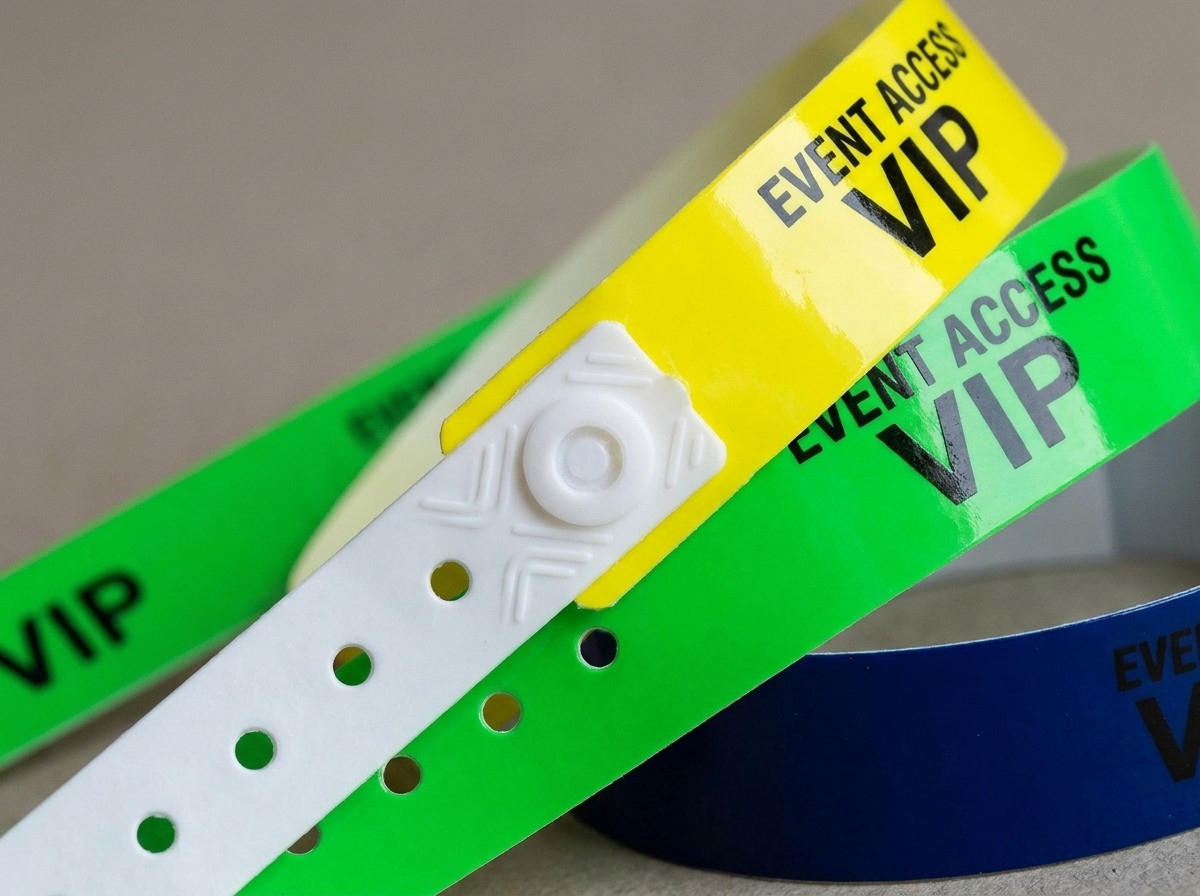
Vinyl wristbands are manufactured from flexible PVC, making them significantly more durable than Tyvek. They are waterproof, sweat-resistant, and maintain their integrity across multi-day wear. This makes them the preferred choice for:
- VIP and premium tiers where longevity and perceived quality matter
- Multi-day festivals and camping events
- Hotel and resort access (pool, spa, all-inclusive beach areas) where bands are worn continuously for days at a time
- Staff and crew credentials that must last the full production period, including load-in and load-out
Vinyl wristbands also accommodate a wider range of printed finishes and remain legible and presentable after extended exposure to moisture. The snap or buckle closures used on vinyl bands are engineered to be equally tamper-evident as Tyvek alternatives.
Machine-Readable Identifiers: Barcodes, QR Codes, and Sequential Numbering
Colour coding handles visual access checks efficiently, but some events require an additional layer of verification — particularly where fraud risk is higher, where capacity must be strictly enforced, or where post-event reporting matters. Printed machine-readable identifiers on wristbands address all of these needs without adding hardware complexity.
Barcodes
A standard linear barcode printed on a Tyvek or vinyl wristband can be scanned by any handheld barcode reader or a smartphone app. At entry, a scanner confirms ticket validity against a database in real time, preventing duplicate use. Barcodes are compact and can be integrated into the wristband design without dominating the visual layout. They are particularly effective at events where pre-registered tickets need to be converted into physical credentials at a registration desk.
QR Codes
QR codes carry more data than linear barcodes and are readable by virtually every modern smartphone camera without a dedicated app. For organisers who want guests to self-check-in, or who want to link the wristband to a digital profile, loyalty scheme, or agenda, a QR code is the better choice. The code can encode a unique URL, a registration ID, or a zone-permission code. Printed at HD resolution on Tyvek or vinyl, QR codes scan reliably even after a day of wear.
Sequential Numbering
Sequential numbering is the simplest machine-readable (or human-readable) identifier. Each wristband in a batch is printed with a unique number — 0001, 0002, 0003, and so on. This enables precise inventory control: you know exactly how many bands were issued, and a specific number can be flagged as lost, stolen, or revoked. For controlled-capacity events where total attendance must not exceed a fire-safety limit, sequential numbering provides a clean audit trail. It also allows staff to locate a specific wristband if a complaint or incident arises post-event.
All three identifier types — barcodes, QR codes, and sequential numbering — can be combined on a single wristband, and the artwork is handled as part of the free graphic design service. An organiser simply specifies which identifiers they need; the production team builds the print-ready file accordingly.
Entry Flow Design: Eliminating Bottlenecks at the Gate
The wristband is only one component of an effective entry system. How the physical entry process is laid out — the lanes, the staffing, the sequencing of checks — determines whether your investment in quality credentials translates into a smooth guest experience.
Lane Segmentation
Separate entry lanes for different access tiers dramatically reduce congestion. General admission guests — who make up the bulk of your crowd — should have the most lanes. VIP guests, who arrive in smaller numbers but expect faster service, benefit from a dedicated express lane. Staff and crew should have a separate credentialing point, ideally at a side or rear entrance, so that their repeated entries and exits do not interact with public flow at all.
Wristbanding Stations vs. Pre-Banded Entry
There are two models for distributing wristbands: either guests arrive already wearing their band (distributed by post, at a separate registration event, or at hotel check-in), or they are banded at the gate. Pre-banding speeds up entry enormously and is increasingly common for hotel and resort access. Gate banding allows for real-time verification of ticket validity before the band is issued, which reduces fraud. Hybrid models — where standard tickets are exchanged for wristbands at a fast-moving banding station separate from the entry gate — offer a good balance.
Staffing and Briefing
Even the best wristband system fails if staff are not briefed on the colour scheme. Print a laminated reference card for every control point. Brief staff at the start of each day, not just the start of the event. Assign at least one senior steward per zone to make judgment calls when ambiguity arises. For multi-day events, change the wristband colour each day so that yesterday's expired band is immediately obvious.
Planning for Last-Minute Changes
Events rarely go exactly to plan. Guest lists grow. A sponsor requests additional backstage passes at 9 a.m. on the morning of the show. A group booking arrives with different requirements than originally communicated. Having a supplier capable of same-day Tyvek production — with no rush surcharge — means these changes do not become crises. Orders placed in the morning can be printed, packaged, and dispatched via DHL Express or FedEx Express the same day, arriving before doors open in many urban markets.
Common Access-Management Mistakes and How to Avoid Them
Even experienced event organisers repeat the same access-control errors. Awareness of these pitfalls is the first step to avoiding them.
Underordering and Running Out of Wristbands
Running out of wristbands mid-event is one of the most disruptive failures an organiser can face. The solution is to order a buffer of at least 10–15% above expected attendance. Wristbands are an inexpensive line item relative to total event budget; the cost of the buffer is trivial compared to the reputational damage of an entry crisis. And if a supplier fails to deliver, a backup supplier with same-day production capability can rescue the situation — which is precisely the scenario that rapid-production services exist to solve.
Choosing a Single-Colour Scheme Without Differentiation
Using the same wristband design for all attendees makes zone control impossible. Even if budget is tight, a two-tier system — general and VIP, or access and no-access — is worth the marginal extra cost. The design overhead is zero when artwork is included free of charge.
Ignoring Durability Requirements
Ordering lightweight Tyvek for a multi-day outdoor camping event where bands will be worn in the rain, through swimming, and overnight is a false economy. Bands that degrade or detach force stewards to make judgment calls about whether a damaged band was legitimately worn — which opens the door to both genuine fraud and unfair denial of access. Match the material to the duration and conditions of wear.
Forgetting to Test Barcode Scannability
If your entry system relies on scanning barcodes or QR codes, test the entire workflow — scanner hardware or app, database, network connection — before the event opens. A barcode printed at too small a size, or a QR code that has degraded after a day of wear, can bring a scanning-based entry system to a halt. Specify HD print resolution for any wristband carrying a machine-readable code.
No Contingency for the Day Before
The most avoidable crisis in event management is discovering the night before an event that wristbands have not arrived, or that a supplier has let the organiser down. Organisers who have experienced this once invariably build a contingency into their production schedule. Choosing a manufacturer that can print Tyvek on the same day an order is placed — and ship via express courier — converts a potential catastrophe into a manageable inconvenience.
Access management built around well-designed, material-appropriate wristbands does not need to be expensive or complicated. The combination of a clear colour system, the right material for each tier, machine-readable identifiers where needed, and a reliable production partner covers the vast majority of event scenarios from a fifty-person private function to a fifty-thousand-person festival.