


What Is an Anti-Transfer Closure?
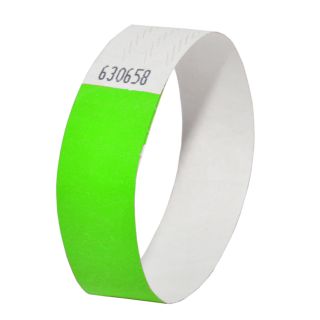
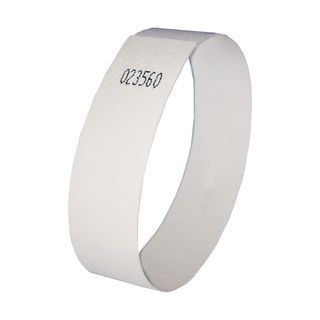
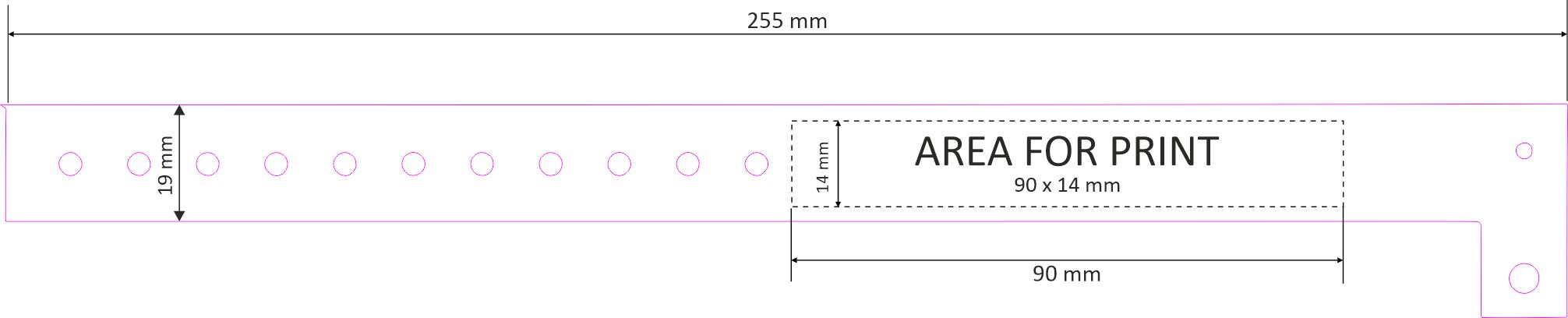
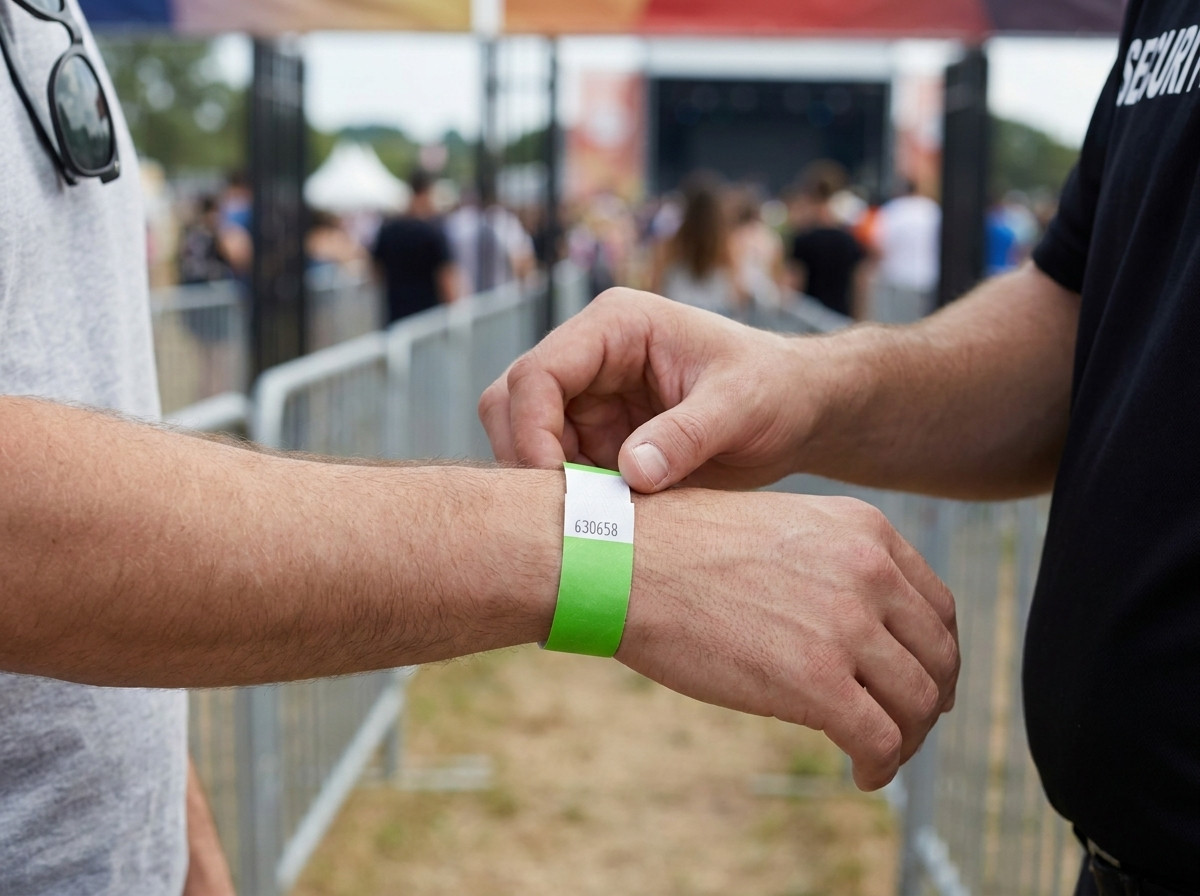
An anti-transfer closure is an adhesive fastening system designed so that a wristband, once applied to a person's wrist, cannot be removed intact and reapplied to a different wrist. The closure is typically located at the overlapping tail of the wristband, where the printed strip folds back on itself and sticks to a specific receptor zone.
The key engineering principle is irreversible bond failure. Two distinct mechanisms are used, sometimes in combination:
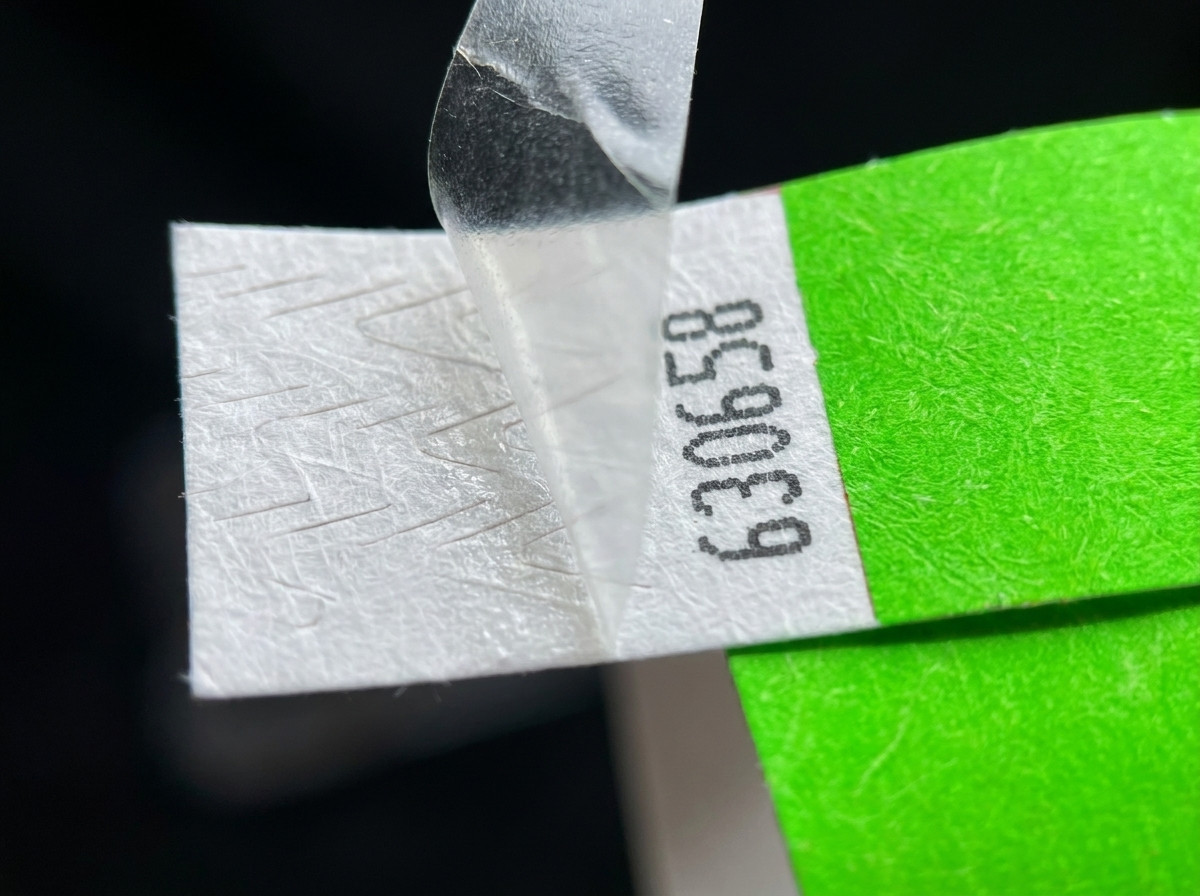
- Substrate tear-on-removal: The adhesive bond is stronger than the tensile strength of the wristband material in that zone. When someone pulls the closure apart, the substrate — Tyvek or vinyl — tears visibly, making re-use impossible.
- Void / de-lamination printing: The adhesive layer carries a hidden ink that transfers onto the receptor surface when the closure is peeled away, leaving a visible «VOID» or similar text on both the adhesive side and the receptor zone. Even if the wristband material does not tear, the security print exposes the tampering instantly.
High-quality anti-transfer wristbands combine both methods. The material tears and a void pattern becomes visible, leaving no ambiguity for door staff. This dual-layer approach is what separates a genuinely tamper-proof wristband from a marketing claim.
Materials Used With Anti-Transfer Closures
Not every wristband material lends itself equally well to anti-transfer closure technology. The two materials most commonly and most effectively paired with anti-transfer adhesives are Tyvek and vinyl (PVC).
Tyvek Anti-Transfer Wristbands
Tyvek is a high-density polyethylene fibre sheet manufactured by DuPont. It has a paper-like appearance and feel but is far more resistant to tearing under normal handling — yet it tears cleanly and predictably when an anti-transfer adhesive is applied and then forcibly separated. This combination makes it the most popular substrate for anti-transfer wristbands at high-volume events.
Tyvek wristbands with anti-transfer closures are lightweight, cost-effective, and printable at very high speed — which is why same-day production is achievable. When an event organiser contacts us in the morning with an urgent order, we can print, cut, and package Tyvek wristbands with fully functional anti-transfer closures in a matter of hours, with no rush surcharge. This is not an exceptional service; it is standard practice for how we operate.
Tyvek is also water-resistant, meaning the closure integrity is not compromised by sweat, rain, or pool splashes — critical for outdoor festivals and water parks.
Vinyl (PVC) Anti-Transfer Wristbands
Vinyl wristbands are thicker, more durable, and designed for multi-day or multi-week use. They are the material of choice for festivals spanning several days, hotel guests who need wristband access for an entire holiday, or conferences where access control must hold for three to five days.
Anti-transfer closures on vinyl wristbands typically use a snap-lock or adhesive tab system engineered into the PVC material itself. The closure is one-directional: it clicks shut and cannot be undone without cutting or visibly distorting the plastic. Attempting to remove a vinyl anti-transfer wristband leaves a deformed closure that no staff member would accept as valid.
Our vinyl wristbands are manufactured in-house, allowing full quality control over the closure mechanism. We do not source from third parties and then rebrand — we produce the wristbands ourselves, which means tighter tolerances and consistent closure performance across every unit in a batch.
Why Anti-Transfer Closures Matter: The Fraud Problem at Events
Wristband fraud is more common than most organisers acknowledge publicly. The mechanics are simple: a paid attendee hands their wristband to a friend who has not purchased a ticket, that friend enters the event, then passes the wristband back out (or over a fence), and a third person enters. With a standard adhesive closure — or a simple snap — this cycle can repeat dozens of times across a single event.
The financial impact compounds quickly. At a festival with 5,000 attendees and a ticket price of £40, even a 5% fraud rate represents £10,000 in lost revenue. Anti-transfer closures eliminate this vector entirely at a marginal cost that is a tiny fraction of the losses they prevent.
Beyond revenue, there are safety and legal considerations. Events with a legal capacity limit cannot allow fraudulent over-entry without risking licence violations and safety hazards. Anti-transfer wristbands give security staff an unambiguous, instant visual check: intact closure means the wristband is original; damaged closure means tampering.
Hotels with all-inclusive bracelets face a parallel problem: guests sharing pool or restaurant access with non-paying visitors. A vinyl anti-transfer wristband applied at check-in ensures that access rights belong to the person wearing the wristband, not to whoever borrowed it that afternoon.
Combining Anti-Transfer Closures With Other Security Features
Anti-transfer closures are the physical security layer, but they work best when combined with visual and digital identification features printed onto the wristband itself. The following combinations are all compatible with our Tyvek and vinyl production:
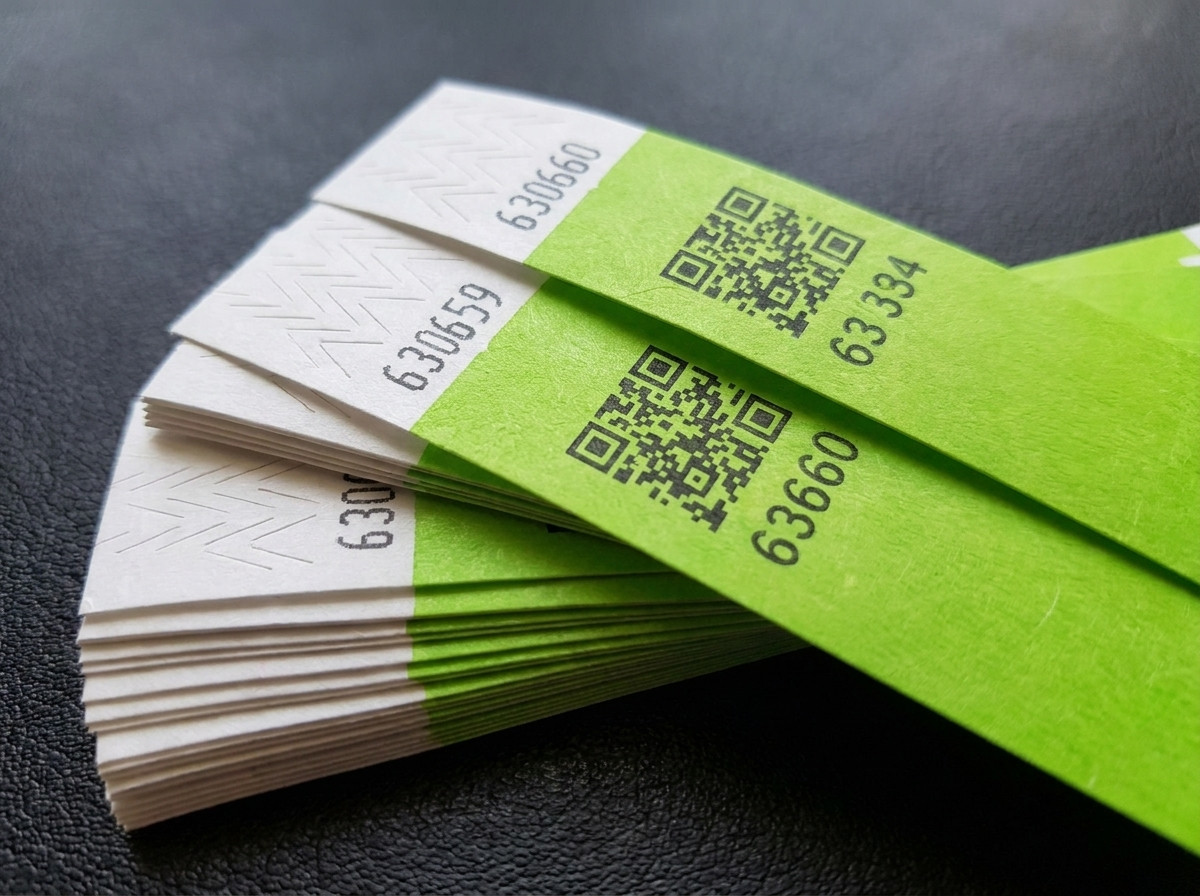
- Sequential numbering: Each wristband receives a unique printed number. Staff can cross-reference numbers against a guest list or ticket database, making it impossible to create counterfeit wristbands even if the material itself were somehow sourced.
- Barcodes: A standard barcode (Code 128, EAN, or similar) printed directly on the wristband allows scanners at entry points to validate the wristband against a real-time database. Combined with an anti-transfer closure, this eliminates both borrowing (physical fraud) and forgery (digital fraud).
- QR codes: QR codes carry more data than barcodes and can encode event-specific information, access tiers, or booking references. A QR code on an anti-transfer wristband that is scanned on entry and flagged as «already used» is a powerful combination against both sharing and counterfeiting.
- Custom colours and print zones: Using different wristband colours for different access levels (VIP, general admission, backstage) is a fast visual cue for staff. When combined with tamper-proof closures, colour coding becomes a reliable security layer rather than a decorative choice.
- HD printing with fine-detail artwork: High-definition printing of complex logos, micro-text, or intricate patterns makes visual counterfeiting significantly harder. Our free graphic design service creates print-ready artwork that maximises the use of these security-by-design visual features.
The practical recommendation for most events is to combine at least two of the above with an anti-transfer closure. For large festivals or events with significant revenue at stake, the triple combination of anti-transfer closure, sequential numbering, and QR code scanning provides a robust security posture at very low cost per unit.
Ordering Anti-Transfer Wristbands: Speed, Design, and Delivery
One of the most persistent myths about security wristbands is that they require long lead times. Anti-transfer closures are sometimes assumed to be a specialist feature that needs weeks of production. In practice, for Tyvek wristbands, same-day printing is entirely achievable. Orders placed in the morning can be printed, quality-checked, and packaged the same day — without any rush surcharge added to the invoice.
Vinyl anti-transfer wristbands require slightly more production time due to the thickness and snap-lock assembly process, but express production timelines are still significantly faster than industry standard. Once production is complete, orders ship via DHL Express or FedEx Express, reaching most European destinations within 24 to 48 hours and international destinations within two to three business days.
This combination of rapid manufacturing and express logistics is why event organisers in crisis situations — where a previous supplier failed, or where wristbands were simply forgotten in the chaos of event planning — regularly turn to us. We have produced and delivered fully printed, anti-transfer wristbands for events less than 48 hours away. This is not luck; it is the result of owning our manufacturing process end to end.
The design process is equally streamlined. Customers do not need to supply print-ready artwork or have a graphic designer on staff. Our free graphic design service takes a brief — a logo file, a colour preference, a name or tagline — and produces professional, print-optimised artwork at no additional cost. This removes the single biggest delay point in most wristband orders: waiting for artwork approval from a third-party designer.
Pros, Cons, and Practical Recommendations
Anti-transfer closures are not the right solution for every situation. Understanding their strengths and limitations leads to better purchasing decisions.
Advantages
- Definitive fraud prevention: The tamper-proof closure eliminates wristband sharing, the most common form of event access fraud.
- Instant visual verification: Security staff need no technology — a glance at the closure reveals whether tampering has occurred.
- Cost-effective security: The unit cost uplift for an anti-transfer closure versus a standard closure is minimal, especially relative to the revenue protection it provides.
- Compatible with all print features: Barcodes, QR codes, sequential numbering, and custom HD printing all work alongside anti-transfer closures without compromise.
- Available in fast turnaround: Same-day production for Tyvek means there is no excuse for arriving at an event without the right security wristbands.
Limitations
- One-size-fits-one: Once applied, the wristband cannot be adjusted. Staff applying wristbands must be careful about tightness, particularly for children or guests with medical conditions affecting circulation.
- Not reusable: By design, anti-transfer wristbands are single-use. This is a feature, not a bug — but it does mean they generate waste. Tyvek is recyclable, which mitigates the environmental consideration somewhat.
- Staff training required: The security value of an anti-transfer closure is only realised if door staff know to check the closure and understand what a tampered closure looks like. A brief staff briefing before doors open is essential.
- Not suitable for spa or heavy water immersion (Tyvek): While Tyvek is water-resistant, extended submersion — such as in a spa pool over several hours — can eventually weaken the adhesive bond. For aquatic environments with long-duration wear, vinyl anti-transfer wristbands are the correct choice.
Recommendations by Use Case
- Single-day music festival: Tyvek anti-transfer wristband with QR code or barcode and custom full-colour HD print.
- Multi-day festival (2–5 days): Vinyl anti-transfer wristband with sequential numbering and custom print per access tier.
- Hotel all-inclusive access: Vinyl anti-transfer wristband, one colour per stay period or access level, with barcode linked to guest management system.
- Corporate conference or trade show: Tyvek anti-transfer wristband with sequential numbering and QR code for session tracking.
- Theme park or attraction: Vinyl anti-transfer wristband with barcode for turnstile integration and colour coding for different ticket types.